10 Best Industrial Control Systems for Efficient Automation Solutions?
In today’s fast-paced manufacturing landscape, industrial control systems play a crucial role. These systems enhance efficiency and productivity across various sectors. Their importance cannot be overlooked.
Modern industrial control systems automate processes, reducing the need for manual intervention. They use advanced technology to monitor and control machinery. This ensures higher precision in operations.
However, not all systems are created equal. Some may offer advanced features but lack user-friendliness. Users often struggle with complex interfaces. It is essential to choose a system that meets specific needs. Careful evaluation of options is necessary for optimal performance.
Top Features of Industrial Control Systems for Automation Efficiency
Industrial control systems (ICS) play a vital role in automation. They streamline operations and enhance efficiency across sectors. A key feature of these systems is real-time monitoring. This capability allows companies to track performance and respond quickly to issues.
Predictive analytics is another valuable feature. By analyzing data, businesses can anticipate problems before they escalate.
Scalability is essential for modern automation solutions. Systems should be flexible enough to grow with the company. Integration with existing machinery is crucial as well. When systems work together, productivity improves significantly. Security must not be overlooked. As connectivity increases, vulnerabilities arise. Reliable systems prioritize robust security measures to safeguard operations.
User-friendly interfaces enhance operational efficiency. A well-designed dashboard simplifies complex data, allowing for quicker decision-making. Training staff on ICS is often an area for improvement. Many organizations overlook this. Knowing how to harness the full potential of the system is vital. Regular updates and maintenance can also pose challenges. Companies must stay proactive to maintain peak performance.
Key Industry Trends in Industrial Control Systems for 2023
The landscape of industrial control systems (ICS)
is evolving rapidly in 2023.
Companies are increasingly focusing on automation to enhance efficiency and reduce costs. This surge in automation presents vital trends to consider.
A significant trend is the integration of artificial intelligence (AI)
into ICS. AI enhances predictive maintenance, facilitating timely interventions and minimizing downtime.
It also optimizes resource allocation, making processes smoother.
Another critical trend is the move toward open architectures.
This approach encourages interoperability among various systems. By adopting open architectures, companies
can avoid vendor lock-in. This flexibility allows for innovative solutions tailored to specific needs.
Furthermore, enhanced cybersecurity measures are essential as ICS becomes more interconnected.
Organizations must invest in robust security frameworks to protect against potential threats and vulnerabilities.
Tips: Focus on your specific needs when choosing a system.
Assess the scalability and compatibility of your ICS with existing infrastructure. Regular training for staff
is equally important to ensure optimal usage and safety protocols are understood and followed.
As the landscape changes, reflecting on past choices can guide future decisions.
Comparison of Leading Industrial Control Systems by Market Share and Performance
Selecting the right industrial control system (ICS) is critical for improving operational efficiency. Market research indicates that industries utilizing advanced ICS can reduce operational costs by up to 30%. Most of the leading systems show superior performance metrics. Companies often report a significant return on investment within one to two years.
However, performance is not uniform across all systems. Some platforms might excel in data management but lag in user interface design, leading to a frustrating experience. For managers, understanding these strengths and weaknesses is vital.
Tip: Evaluate your specific needs before implementation. Conduct thorough assessments and prioritize functionalities that align with your operational goals.
The market for industrial control systems remains competitive, with emerging technologies continuously reshaping the landscape. A recent analysis pointed out that systems utilizing machine learning demonstrate enhanced predictive capabilities, which can yield higher uptime rates. This illustrates the necessity for ongoing education in technology trends for teams involved in system selection and maintenance.
Tip: Stay updated with industry reports to make informed decisions. Regular training sessions can enhance team proficiency in modern ICS features.
Impact of IoT Integration on Industrial Control Systems' Efficiency
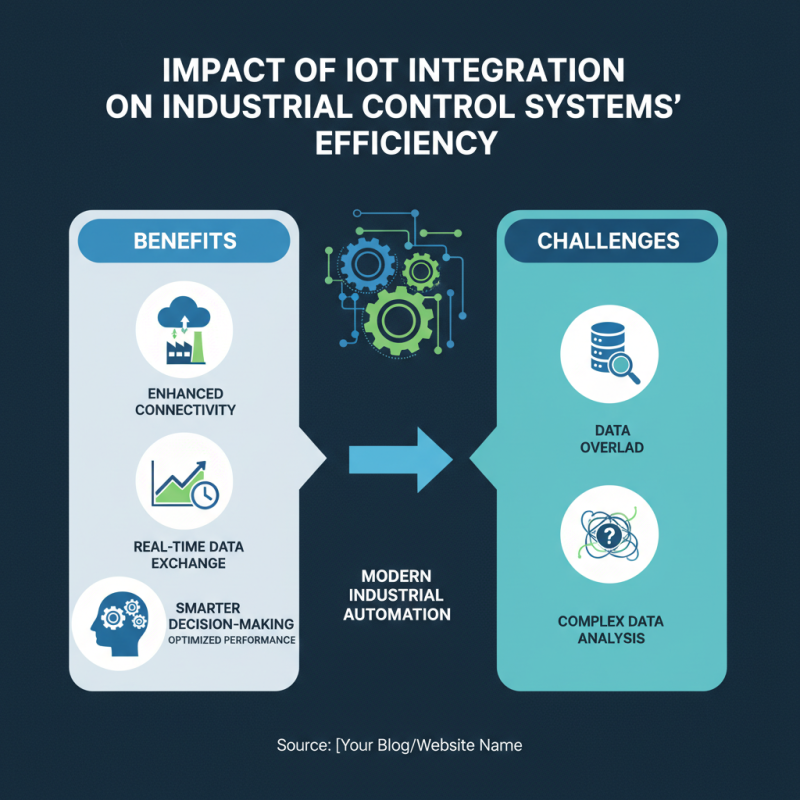
The integration of IoT technology into industrial control systems has transformed the landscape of automation. IoT enhances connectivity and facilitates real-time data exchange among machines. This leads to smarter decision-making processes and optimized performance, crucial for modern industries. However, the implementation of IoT is not without challenges. Many companies struggle with data overload, making analysis difficult.
Security also poses a significant concern. As more devices connect, threats increase. Companies must ensure their systems are robust against cyber-attacks. Ongoing training for employees is essential to maintain operational efficiency and security. Furthermore, some firms may find the transition daunting. Older systems might require significant upgrades, impacting budgets and timelines.
Despite these challenges, the benefits are substantial. Enhanced monitoring can lead to predictive maintenance. Businesses can identify potential issues before they escalate, decreasing downtime and costs. The evolving nature of IoT in industrial control systems urges professionals to remain adaptable and rethink strategies continuously. This evolution is essential for maintaining competitive advantages in an increasingly automated world.
Future Innovations in Industrial Control Systems and Their Potential Benefits
The future of industrial control systems (ICS) is poised for transformative changes. Innovations are driving automation solutions towards greater efficiency and adaptability. According to a recent report by the International Society of Automation, the global ICS market is expected to reach $203 billion by 2026, growing at a CAGR of 7.1%. This growth reflects a demand for smarter, more flexible systems.
Advanced technologies like AI and machine learning are reshaping how these systems operate. For example, predictive analytics allows for real-time monitoring, enabling preemptive maintenance. This reduces downtime and increases production efficiency. However, challenges remain. Many organizations struggle to integrate these emerging technologies into legacy systems, posing risks if not addressed thoughtfully.
Moreover, the potential benefits of adopting advanced ICS include enhanced safety and reduced operational costs. A report from McKinsey emphasizes that companies implementing these technologies can reduce costs by up to 30%. Yet, the transition requires careful planning. It’s vital to ensure that staff are trained and that systems are compatible. Balancing innovation with existing frameworks is crucial for success. As the landscape evolves, organizations need to reflect on their strategies to harness the full potential of these advancements.