Top 10 Control Systems You Should Know About?
Control systems play a crucial role in various industries, enhancing efficiency and accuracy. According to a report by Fortune Business Insights, the global control systems market is projected to reach over $296 billion by 2028, growing at a CAGR of 6.8%. This surge highlights the increasing reliance on automation and precise control across sectors like manufacturing, aerospace, and energy.
In the realm of industrial automation, control systems are essential for optimizing processes. They help minimize errors and maximize productivity. For instance, PID controllers, which are commonly used, can significantly improve response times in automated tasks. However, there are challenges. Many companies still struggle with integrating new systems into existing frameworks. Not all organizations fully leverage the benefits of modern control technologies.
As we explore the top 10 control systems, it's essential to recognize their transformative impact on our daily operations. Yet, it's also vital to address the learning curve and potential pitfalls. Embracing innovation in control systems requires both investment and a willingness to adapt. Balancing technology with practical implementation remains a key hurdle for many.
Overview of Control Systems in Engineering
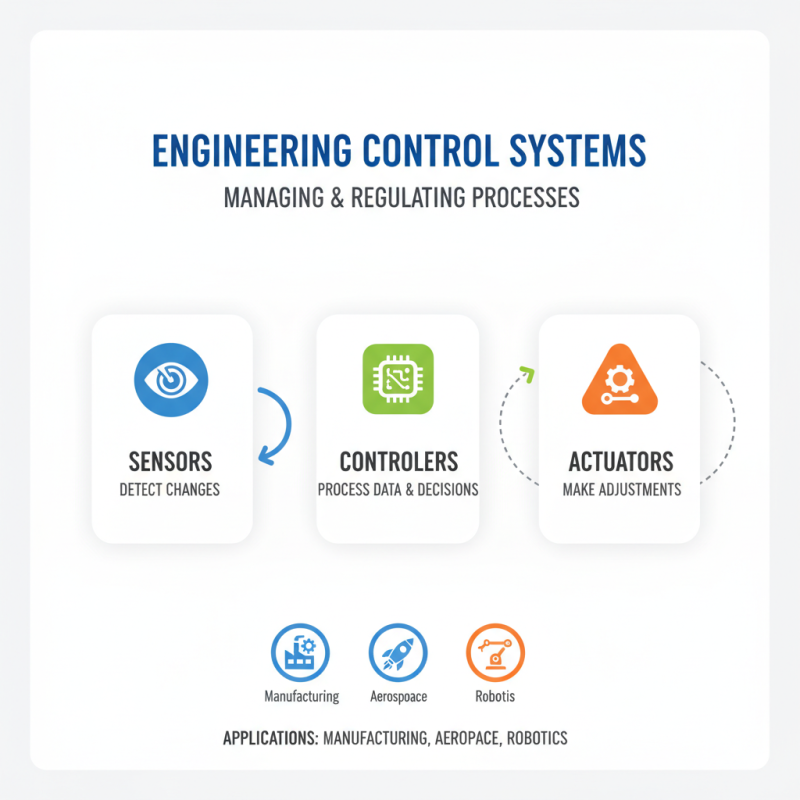
Control systems play a crucial role in engineering. They help manage and regulate various processes in industries like manufacturing, aerospace, and robotics. These systems can be simple or complex. At their core, they consist of sensors, controllers, and actuators. Each component has a specific function. Sensors detect changes in the system, controllers process this data, and actuators make the necessary adjustments.
An effective control system is vital for precision and efficiency. For instance, in temperature control, sensors measure current temperatures. The controller then decides how much energy to supply to heating elements. This feedback loop continues until the desired temperature is reached. However, achieving optimal performance can be challenging. Delays in response or inaccuracies in measurement can lead to inefficiencies.
It's important to realize not all control systems work perfectly. They may exhibit oscillations or unforeseen behaviors. Engineers must continuously analyze system performance. This requires a deep understanding of both the theory and practical applications. Miscalculations can result in critical failures. Thus, refining and improving control systems is an ongoing process in engineering fields.
Key Characteristics of Effective Control Systems
Effective control systems are crucial in various industries. They ensure efficiency and help mitigate risks. Recent studies show that organizations with strong control systems report a 30% improvement in operational efficiency. Key characteristics play a vital role in achieving these results.
Transparency is one essential trait. Teams must understand goals and expectations. Without clarity, employees may misinterpret their roles. Moreover, adaptability allows control systems to respond to changes. The latest industry reports highlight that 40% of firms struggle to adapt quickly. This rigidity often leads to inefficiency and missed opportunities.
Another important aspect is feedback loops. These help monitor performance continuously. A report revealed that organizations with regular performance reviews improve their outcomes by 25%. However, creating robust feedback channels can be challenging. Many teams fail to act on feedback, diminishing the control system's effectiveness. Continuous improvement requires commitment from all levels within an organization. Understanding these key characteristics is crucial for anyone looking to enhance their control systems.
Introduction to PID Controllers and Their Applications
PID controllers are fundamental in modern control systems. They help maintain desired output levels in industrial processes. A study from the International Society of Automation indicates that over 90% of control loops in industry use PID controllers. This widespread adoption highlights their effectiveness.
PID stands for Proportional, Integral, and Derivative. Each component plays a unique role. The proportional term adjusts output based on the current error. The integral term considers past errors. Finally, the derivative term predicts future errors. Together, they enhance system stability. Yet, tuning a PID controller can be challenging. Improper settings can lead to oscillations or sluggish responses.
Applications of PID controllers are vast. They are used in temperature control, motor speed control, and flow regulation. For instance, in temperature control systems, a poorly tuned PID can lead to overheating or underheating. According to a report by the Control Systems Society, nearly 30% of control system failures arise from inadequate PID tuning. This underlines the importance of understanding PID principles for optimal performance.
Top 10 Control Systems You Should Know About
| Control System |
Type |
Applications |
Advantages |
Disadvantages |
| PID Controller |
Feedback Control |
Industrial automation, robotics |
Simple design, widely used |
Tuning can be complex |
| Lead-Lag Compensator |
Continuous Control |
Signal processing, stabilization |
Improves phase margin |
Can introduce delay |
| Fuzzy Logic Controller |
Rule-based Control |
Nonlinear systems, temperature control |
Handles uncertainty well |
Less precise compared to PID |
| Sliding Mode Controller |
Robust Control |
Robotics, automotive systems |
Robust against disturbances |
Chattering phenomenon |
| State Space Controller |
Modern Control Theory |
Complex systems, multi-variable control |
Handles multiple inputs/outputs |
Mathematical complexity |
| Neural Network Controller |
Intelligent Control |
Adaptive systems, predictions |
Learns from data |
Requires large datasets |
| Model Predictive Controller |
Optimization Control |
Process control, robotics |
Handles constraints efficiently |
Computationally intensive |
| Adaptive Controller |
Dynamic Control |
Aerospace, robotics |
Adjusts to system changes |
Complex design and tuning |
| Hybrid Controller |
Mixed Method Control |
Automotive, HVAC systems |
Combines multiple techniques |
Complex architecture |
| Digital Controller |
Discrete Control |
Computers, electronics |
Precision and repeatability |
Subject to quantization errors |
Exploring State-Space Representation in Control Systems
State-space representation is a pivotal concept in control systems. It provides a structured way to model dynamic systems. In this framework, state variables encapsulate the system's current conditions. These variables offer valuable insights into system behavior. They also help in system management and prediction.
When utilizing state-space models, it is important to grasp the underlying dynamics. Often, practitioners face challenges in defining the correct state variables. For example, in mechanical systems, identifying positions and velocities can be tricky. There may be confusion about what to include. This ambiguity often leads to oversimplified models, which do not capture real-world complexities.
Moreover, feedback in state-space representation can enhance control. However, designing effective feedback loops is not always straightforward. Designers must carefully analyze signal interactions. Misinterpretations can lead to instability or poor performance. Reflecting on these aspects is crucial for developing robust control systems. Understanding the intricacies of state-space can ultimately lead to more efficient solutions.
Top 10 Control Systems You Should Know About
This bar chart represents the performance metrics of various control systems, focusing on their stability, speed of response, and robustness. Each system is evaluated based on a hypothetical scale from 1 to 100.
Future Trends in Control System Technologies
The future of control system technologies is thrilling. Innovations are emerging rapidly. These advances reshape industries. Automation is becoming more intelligent. Algorithms are now capable of predictive analytics, enhancing decision-making capabilities. This shift allows for increased efficiency across various operations.
Tips: Embrace curiosity. Explore new trends regularly. Understand that learning is a continuous journey. Consider how AI can be integrated into your projects.
Another trend involves the Internet of Things (IoT). More devices are becoming interconnected. This leads to real-time data collection and analysis. With this data, control systems can respond swiftly to changes. Yet, the increase in data can be overwhelming. Reflection on data management strategies is vital.
Tips: Prioritize data security. Stay updated on best practices. Remember, not every technology suits every situation. Evaluate the relevance before implementation.